
LGR and DEVOLUTION Can it help unlock more new homes and critical regeneration and infrastructure projects in our centres?
 | Dr Steven Norris (MRTPI) is an Executive Director at LSH, and national head of the Planning, Regeneration + Infrastructure (PR+I) business. Steve also heads up the specialist Town Centre & Economic Regeneration team, and has advised on town centre planning, regeneration and development for over 32 years. He was also previously an expert adviser on the government’s High Street Task Force up until its dissolution in 2024. Chris Ives is a consultant acting for LSH out of our Manchester office, and has 30+ years’ experience in urban regeneration. Chris has most recently acted for Wirral Borough Council and Tees Valley Combined Authority on the delivery of complex town regeneration projects. He has also written business cases for the creation of Development Corporations and implemented delivery vehicles for a number of local authorities and public/private partnerships. |
Steve kindly agreed to follow up his presentation at ACES National Conference in Bath with this article. Chris has also contributed to the article, but wasn’t able to attend in Bath as planned. |
Local government reform and devolution
The English Devolution White Paper published in December 2024 set in motion the government’s plans to devolve leadership, decision-taking and budgets from Westminster. This is probably the biggest and most ambitious reorganisation of local government in England in over 30 years.
To deliver effective devolution, the government has initiated Local Government Reorganisation (LGR) – which will replace the current two-tier system of county councils and district councils with a network of larger Strategic Authorities (SAs); with the most far-reaching and flexible powers being given to Mayoral Strategic Authorities.
The government’s aim is to empower local leaders and communities; to give them significantly more autonomy to shape their own futures, and to help address long-standing and deep-seated regional disparities.
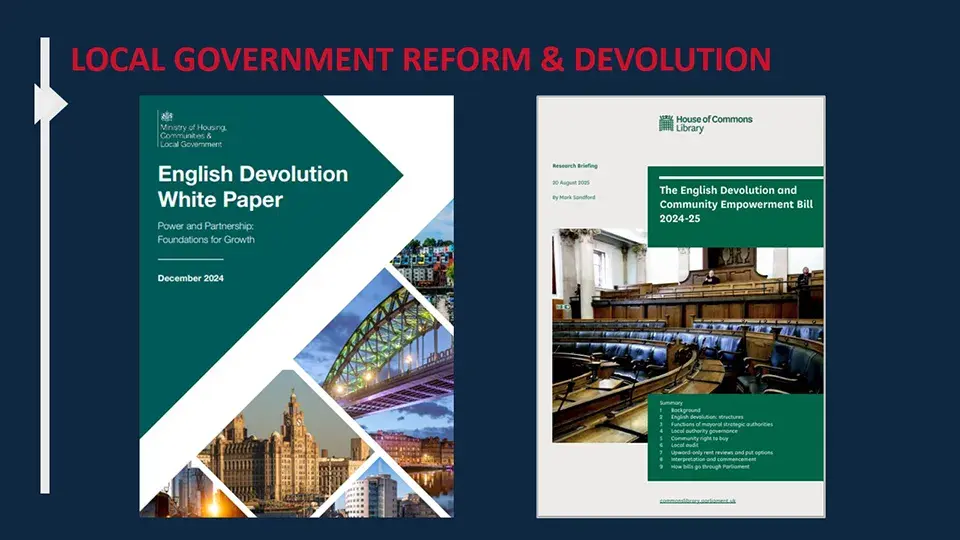
The White Paper was followed by the English Devolution and Community Empowerment Bill in July 2025, which introduces a series of legal frameworks, including standardising what devolved powers are available; how SAs operate; and how communities can acquire important assets locally. The Bill is currently working its way through Parliament, and is likely to receive Royal Ascent in Spring 2027.
Put simply, the government’s aim is to introduce three tiers of SAs across England by the end of this Parliament – namely Foundation, Mayoral and Established Mayoral. The level of devolution powers will vary across regions, but the key areas are:
education and skills
transport and infrastructure
economic development
healthcare and social services; and
housing and planning.
The Bill also enables mayors to charge a Mayoral Community Infrastructure Levy; to designate a Mayoral Development Area and establish a Mayoral Development Corporation (MDC).
Greater financial autonomy also means these devolved authorities are going to be able set the agenda going forward - from spatial planning and infrastructure investment, through to prioritising housing delivery and regeneration projects.
For everyone involved it presents both significant opportunities and challenges.
Who will it impact?
So which authorities and areas are going to be affected by devolution and LGR?
Figure 2 shows the current position. Scotland, Wales, and Northern Ireland already have long-established devolved governments with significant powers, including over planning, transport, and housing. In England, it is more like an unfinished jigsaw. Some areas have embraced devolution through combined authorities with directly elected mayors, including:
Greater Manchester
West Midlands
Liverpool City Region; and
Tees Valley.
These areas have access to the full suite of Tier 3 powers, including strategic planning, transport budgets, and economic investment.

The newer entrants – including the North-East Mayoral Combined Authority, and York and North Yorkshire - are starting to flex their ‘devolved’ muscles. But there are still large parts of England without any formal devolution arrangements – including much of the South-East, East Midlands, and parts of the South-West. It is these remaining two-tier areas – county and district councils – who are going to be brought in line with the other unitary authority government systems.
The process started in February 2025 when the government formally invited all councils in two-tier areas and small neighbouring unitary authorities to submit proposals for unitary local government. As Figure 2 shows, this invitation extended to 21 county councils and the 164 district councils that sit within them.
However, as these complex new deals and structures are discussed and negotiated, there is a concern it will create uncertainty and a potential “paralysis” in decision-making at the local level, leading to delays to plan-making and the delivery of critical regeneration projects. One of the “casualties” of this reorganisation could be the government’s target of universal coverage of local plans by the end of Parliament.
What will be the potential impact on our centres and high streets?
But what will be the potential impact of LGR and devolution on the planning, funding and regeneration of our centres and high streets, and the delivery of new homes? When we asked this question in the 2025 LSH/Revo Research – Shaping Tomorrow’s Places (1) – 61% responded that devolution will have a positive impact (2) (see Figure 3) [Ed – see also Steve’s article in 2025 Autumn Terrier].

Hopefully devolution will also lead to more consolidated, more sustainable and more patient funds, which take a longer term view on development and provide greater certainty for critical place-based regeneration and infrastructure projects. This should help with development viability, and reduce the risk of failure during the lifecycle of projects.
To illustrate further how LGR and devolution can help support the revival and revitalisation of our centres and high streets we have selected two case study examples.
Case study 1 – Hartlepool town centre
Hartlepool town centre sits in the area administered by Tees Valley Combined Authority (TVCA). Hartlepool has a strong history and culture, but like many towns has suffered retail decline over the years.
The town is a regeneration priority for TVCA, but it was concerned that the town’s shopping core – focussed on the Middleton Grange shopping centre - was in need of more proactive management and investment. In response the Mayor established the Hartlepool Development Corporation (HDC) in 2023, and the TVCA completed the purchase of Middleton Grange in December 2024. This purchase was predicated on the preparation of a strong business case and regeneration strategy prepared by Chris Ives.

To support the wider town regeneration, Chris also prepared an evidence-based delivery strategy for a focus area that extended beyond the shopping centre (Figure 4). As part of this strategy, HDC actively engaged with occupiers and the community at the outset to consider and test the options for the transformation of the failing retail space, and to help inform a meanwhile use strategy.
The ambition for HDC is to create a more attractive, more sustainable and more viable destination for businesses, investors, the community, and visitors. This will include a new commercial area and repurposed listed department store; the delivery of more new homes; and creating leisure and event spaces - initially as meanwhile uses - to drive placemaking.
Case study 2 – Stockport town centre
The second example is Stockport, where the Stockport Mayoral Development Corporation has taken a leading role in the regeneration of the town centre since 2019. It is also widely regarded as the UK’s first MDC focussed on a town centre, and is held up as a test case for how mayoral-led delivery structures can help accelerate and deliver complex urban regeneration projects.
Although the MDC does not have plan-making, plan-determining, or CPO powers - relying on Stockport MBC to provide those services – it does have a clear leadership and a delivery strategy that the private sector has confidence in. This is evidenced by the success it has achieved so far. This includes the ongoing regeneration of Stockport 8 (Town Centre West) for a mix of new homes, offices, shops and public realm, and the delivery of transport interchange upgrades and improvements to walking/cycling links (Figure 5).

Conclusion
In conclusion, LGR and devolution could be a game-changer for many areas. For example, both Stockport and Hartlepool town centres have achieved a significant leap forward, with the right leadership and governance structures in place.
The transfer of powers and funding from central to local government means decisions can be made closer to communities. This should lead to more tailored and effective solutions for local issues, fostering economic growth, community engagement, improved public services, and more focussed place-based investment.
Different regions should also be able to identify and choose approaches that are right for their unique circumstances. The danger, however, is that they will be asked to do too much.
It is therefore vital for the government and its agencies to continue to play their role, and not offload all responsibility onto the devolved authorities, as they will potentially be overwhelmed and under-resourced.
The government will also have to improve significantly how it joins up different national policies and priorities across different departments and agencies. For example, the Modern Industrial Strategy has to be aligned with the Strategic Spatial Plan for Energy, the 10-Year Infrastructure Strategy, and with the government’s ambitions to build 1.5 million new homes by the end of parliament. If they are not aligned at the national level, how can they be delivered at the strategic and local level?
This is a golden opportunity for local government to really shape the places they represent, and have a voice that is actually heard in Whitehall. Hopefully, this will ensure that we get strong mayoral candidates who can maximise the benefits of devolution on behalf of the people they represent.
References
LSH/Revo (2025) – ‘SHAPING TOMORROW’S PLACES: Does a new era of government herald a new dawn for the revitalisation and regeneration of our centres?’ https://www.lsh.co.uk/explore/research-and-views/research/2025/july/lsh-revo-report-2025?listing=true
It should be noted the LSH/Revo survey was conducted from the end of January to early March, after the publication of the White Paper, but before the Bill. It will be interesting to see if and how the “mood music” changes in next year’s survey.


Comments