
AI IN ESTATES MANAGEMENT Where AI is earning its place in public sector property

 | Sam is Chief Financial Officer at Re-Leased. He has more than a decade of experience across commercial real estate, finance and technology, including roles at KPMG and Great Portland Estates. His work focuses on the economics of AI adoption, operational efficiency and the use of connected property and financial data. |
Sam explains that from making property information easier to access, to monitoring obligations and reducing routine administration, AI can help under-resourced property teams gain greater visibility and control, while keeping professional judgement firmly with surveyors and property managers. |
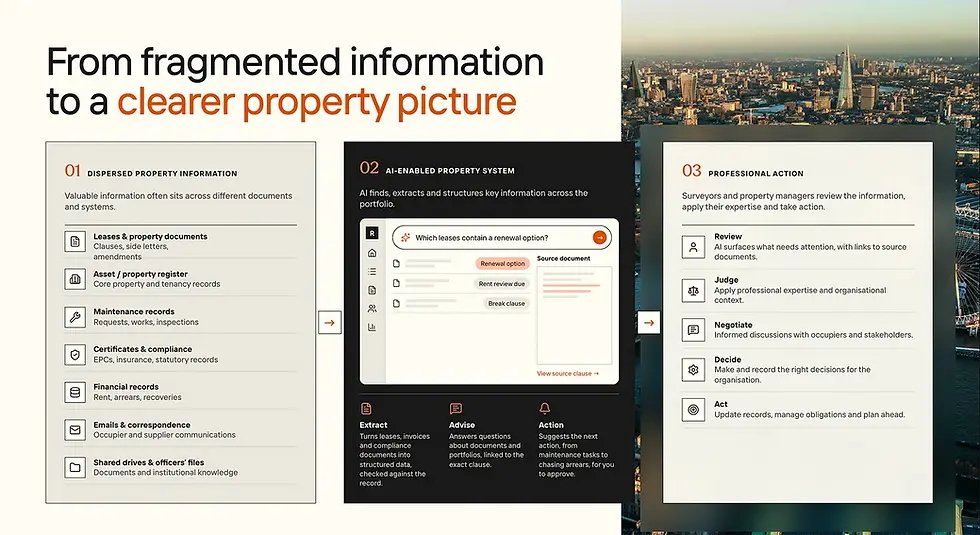
Which of the commercial leases your authority has granted since March contain a renewal option?
A recent change to the law means the answer could affect the rent those leases achieve on renewal and how future income is forecast. Yet answering a question like this can mean searching through leases, spreadsheets, management systems, shared drives, and individual officers' files. For an under-resourced property team, what sounds like a straightforward question can quickly become days of work, and the answer may still be incomplete.
The problem is not necessarily that the information does not exist. It is that finding, checking and using it across an entire portfolio can require significant professional time.
This is where AI is beginning to find practical applications in property. Re-Leased's 2026 research found that lease administration and abstraction is currently the most common AI application among commercial landlords, cited by 60% of those using AI. Tenant communications, compliance and operational workflows are also emerging as areas of adoption.
For property managers and chartered surveyors working across public sector portfolios, the relevance is not AI replacing professional expertise. It is AI taking on some of the document-heavy and repetitive work around it: finding information, checking records, monitoring obligations and preparing routine actions.
For those leading under-resourced property functions, four applications are particularly relevant.
1. Creating an estate record you can interrogate
Lease administration is a logical place to start because so many other property processes depend on it. Commercial leases can run to dozens of pages, follow no common format, and contain critical information across schedules, side letters and amendments. Turning those documents into reliable portfolio data has traditionally required someone to read each one and manually enter selected terms into a system.
That creates a fundamental limitation. A lease register may contain the information somebody decided was important when the record was created, but a new question can still require property managers and surveyors to go back through the original documents.
AI changes what is possible. It can extract terms such as rent review dates, break clauses, renewal options, repairing obligations and notice requirements and, importantly, connect the information back to the clause from which it came.
The same process can be applied at portfolio scale. Rather than abstracting leases individually, AI can process hundreds or thousands of documents, extract key terms consistently, and prepare the information needed to populate or refresh the asset register. Each extracted field should remain linked to its source clause. Material changes can be reviewed and approved by the responsible surveyor or property manager, then written back to the system of record without somebody having to rekey the information.
Once that information is structured, questions that previously became research projects can become portfolio queries. Which leases contain renewal options? Which reviews fall due this quarter? Which break notices need to be served in the next 18 months? Which properties place a particular repairing obligation on the landlord? Where AI is embedded in the property management system, each can be answered by asking it directly.
The forthcoming ban on upwards-only rent reviews illustrates why that capability matters. The English Devolution and Community Empowerment Act, which became law in April, will apply the ban to new and renewed commercial leases in England and Wales once the relevant regulations take effect. A late amendment means certain renewal options dated from 17 March 2026 may bring the renewed lease within scope.
For chartered surveyors and property managers, the important capability is not simply having the relevant leases somewhere in the organisation. It is being able to identify the affected leases quickly, understand the relevant provisions, and trace the information back to its source before a decision is made.
2. Moving from periodic checks to portfolio-wide assurance
The bigger opportunity is not simply making information easier to find. It is making it possible to check far more of the portfolio, far more frequently.
Senior property managers and surveyors are responsible for obligations spread across leases, certificates, inspections, financial records and regulatory requirements. The challenge is often not knowing what should happen. It is maintaining assurance that it has happened across every relevant property.
Published council audits show the consequences when information and processes become fragmented. Reviews have identified rent reviews running years late, potential lost income, missing leases and approvals, delayed billing, and evidence that could not initially be produced because it was accessible to only one officer.
The issue is financial as well as operational. When property information is fragmented, the financial consequences are rarely confined to administrative inconvenience. They appear as delayed reviews, missed income, backdated billing, and professional time spent reconstructing information that the organisation already holds.
Check 5% of your data once a year, or 100% of it every day.
Auditing lease data by hand has always meant sampling. Commercial property businesses typically audit around 5% of their portfolio data each year and use that sample as a proxy for the rest. Comparing every field in the property system with every lease, contract, insurance certificate, and source document was never a realistic use of professional time.
AI changes the economics of that work. Where documents and systems are connected, it can compare the full portfolio with the underlying source material continuously, identify missing or conflicting information and surface discrepancies as they appear, rather than waiting for the next audit cycle.
This is not work that estates teams failed to do because they lacked the expertise. Full-portfolio checking at this frequency was simply uneconomic to sustain manually. A recovery that was never billed, or an insurance certificate that quietly lapsed does not appear as a slow process. It appears as lost income or an uninsured claim, often discovered too late.
Full-portfolio data quality is also the foundation on which other AI applications depend. Without reliable source data, AI simply produces answers faster from an uncertain record. With it, property managers and surveyors gain clearer visibility across every lease, confidence that an answer reflects the underlying document and the ability to act on defined trigger events as they occur.
The same principle can be applied to insurance expiries, compliance certificates, overdue reviews and changing regulatory requirements. The responsible surveyor or property manager remains accountable for deciding what an exception means and what should happen next, while professional time is concentrated on the cases that genuinely require it.
3. Protecting institutional knowledge
Knowledge of the public estate often lives in people as much as it does in systems.
A long-serving surveyor or property manager may know why an unusual clause was agreed, where an old wayleave is held, what happened during a previous negotiation, or which tenant requires a particular approach. When that person retires or moves on, the organisation can lose context that took years to build.
There are practical examples of the problem. One council was unable to locate the original agreement for a wayleave affecting an electricity substation; in another commercial property example, an AI review surfaced an obligation to remove a former tenant’s details from the Land Registry. The obligation remained in the lease, but knowledge of it had disappeared as employees changed.
Making the portfolio searchable provides another route into that institutional knowledge.
A new starter, interim surveyor, or shared-service team could ask a question about an asset and retrieve the relevant underlying information without first needing to know who holds the document, what somebody called the file 15 years ago, or which spreadsheet contains the latest version.
It does not recreate the judgement of an experienced colleague. Nor does it capture everything somebody knows about a property. But it can reduce the organisation’s dependence on the one person who remembers where something is held.
For leaders, that is as much a resilience issue as a productivity one.
4. Releasing scarce professional capacity
The fourth application is the volume of relatively small administrative tasks surrounding property management.
Much of the day-to-day risk in a portfolio first appears through the inbox: a maintenance request that is not logged, an insurance certificate that lapses, or a review date that passes without action. Triage is where property managers can lose a significant part of the day, and it is one of the activities that scales least effectively as the portfolio grows.
An occupier reports a leak. Someone needs to identify the property, find the lease, establish the repairing obligation, check previous correspondence, create the job, and prepare a response.
A rent review approaches. Someone needs to find the relevant clause, check the timetable, assemble the information, and prepare the next action.
An arrears issue emerges. Someone needs to establish the tenancy, check the financial position and relevant lease terms, review previous correspondence, and prepare a follow-up.
None of those individual steps is necessarily difficult. Together, across a portfolio, they consume significant amounts of professional time.
Tenant communication and service requests are already the second most common AI application identified in Re-Leased’s commercial research, cited by 39% of active users. The emerging model is not to remove the property professional from the process. AI does the finding and linking: identifying the property, retrieving the relevant information, and preparing a task or response. The person reviews what has been prepared and decides what happens.
There are already indications of how much administrative friction can be removed. In one commercial example, a property manager responsible for more than 300 properties reduced the initial administration of maintenance requests from five or six minutes to under 30 seconds.
Evidence of AI use in property management still comes predominantly from the commercial sector, so those results should not simply be assumed to transfer directly into local government. But the underlying lesson is relevant. For those leading public sector property teams, the useful measure of AI is not how many tools have been adopted. It is whether a defined process takes less professional time, produces fewer errors, or reduces the likelihood of missed income and obligations.
For a stretched estates team, capacity has economic value. If technology can protect income, reduce avoidable errors and give qualified people more time for judgement and negotiation, that is a much stronger return than automating activity for its own sake.
Professional judgement remains with surveyors and property managers
There is an important distinction running through all four
applications. The case for AI in public sector property is not that it should make decisions instead of surveyors and property managers. It is that it can give those property professionals a better view of the portfolio on which to make decisions.
That makes traceability particularly important. If AI identifies a lease obligation, the responsible surveyor or property manager should be able to see the clause behind it. If it flags a discrepancy, the source records should be available for comparison. If it recommends an action, that property professional should be able to understand the evidence, challenge the recommendation, and decide whether to proceed.
The RICS standard on responsible AI use keeps the surveyor’s judgement at the centre of professional practice. Data protection law draws a similar distinction around meaningful human involvement. AI can assemble information and prepare and action; accountability for material decisions remains with the officer.
What responsible adoption looks like
For estates leaders considering where to begin, the foundations matter more than the sophistication of the demonstration.
Start with the data. AI will not repair poor property records simply by being connected to them. Documents need to be accessible, key records need to be identified, and outputs need to be checked against their sources
Require traceability. Every extracted term or recommended action should lead the officer back to the lease clause, certificate or record behind it. A confident answer without a source is not sufficient for professional decision-making
Keep meaningful human oversight. Ask whether AI is embedded in your property management system or sits alongside it as a separate tool. On a platform built for property, AI can handle the administration: finding the lease, identifying the obligation and preparing the task or response. Because it works within the platform's permissions, approval steps and audit trail, it can also act on routine workflows safely, which a general-purpose tool cannot. Material decisions stay with the officer
Choose suppliers carefully. Public sector organisations need to ask what happens to their data, how accuracy is tested at portfolio scale, how security and permissions are handled, how pricing changes as usage grows, and how information can be exported if the contract ends
Begin with one high-friction process. Rather than trying to transform an entire estates function at once, identify one recurring problem, establish its current time, cost and risk, and measure whether a different approach improves it.
This requires the same investment discipline applied elsewhere. The business case should be tested in the same way as any other investment. Establish the current time, cost and risk, identify the outcome that needs to improve, and measure the result. The number of AI tools adopted is not a return on investment.
For many public sector property functions, the lease will be the logical place to begin because it informs so many downstream activities. For others, the strongest case may be compliance evidence, maintenance triage, arrears, or an approaching programme of reviews.
The right starting point is the process consuming scarce professional time while creating a measurable operational risk.
Start with a question
The best place to start with AI may therefore not be with an AI strategy at all. Start with a question your estates team should be able to answer, but currently cannot answer without hours or days of work. Which leases contain a particular obligation? Which rent reviews are outstanding? Which properties have conflicting records? Which certificates expire in the next six months?
Measure how difficult that question is to answer today. Then ask whether technology can make the underlying information more visible, verifiable and actionable.
For a senior property manager or surveyor leading an under-resourced function, that is a more useful test of AI than the sophistication of a demonstration. The purpose is not fewer surveyors. It is fewer hours spent searching for documents, updating spreadsheets and chasing routine processes, and greater visibility across a portfolio that may previously have been too fragmented for any one person to see in full.
Used well, AI can give property managers and surveyors more time for the work that still requires them: judgement, negotiation, strategy and public accountability.


Comments