
LGR AND REGENERATION Place‑led regeneration: How Local Government Reorganisation can help shape an economic future

 | Richard is an Architect and Strategic Director at HLM Architects. He is a leading advisor on place‑based property strategy and regeneration. He helps public sector organisations unlock the full potential of their land and property assets to drive sustainable economic growth and long‑term community value. With extensive experience delivering complex regeneration programmes and masterplans, he supports public bodies to secure private investment and build effective public‑private partnerships. His focus is turning strategic ambition into commercially grounded, deliverable projects that create lasting socio‑economic impact. |
Richard sees LGR as presenting strategic opportunities. Using the tool HLM Place: “By aligning public sector assets, stable funding, institutional capital, and a more effective planning framework, LGR can become the catalyst for a new model of place‑led regeneration”. |
Shifting opportunities
Parts of the UK are approaching a pivotal moment where national policy, economic pressures, and local priorities intersect in ways that are practical rather than theoretical.
Local Government Reorganisation (LGR), the Fair Funding Review 2.0 (FFR), the forthcoming Local Government Pension Scheme (LGPS) Megafund changes, and national planning reform, are converging — and the combined effect could reshape how we think about place‑led regeneration for years to come.
If that sounds dramatic, well then maybe that’s because it is. But let’s not pretend everyone is convinced.
For many in local government, this moment may feel familiar. We’ve been here before, haven’t we? New reforms, new funding models, new expectations. Some will say they already collaborate across boundaries, already share data, and already map assets with partners. And they’re not wrong. Some may meet this with a degree of scepticism — but in local government, a healthy dose of scepticism is almost a defining trait. It’s part of what keeps the sector grounded, accountable, and focused on what genuinely works.
But conversely, scepticism shouldn’t blind us to potential. The policy landscape is shifting in ways that create new opportunities for councils to lead the next era of place‑making. And at the centre of that shift is a simple but powerful idea:
Public sector property, when strategically aligned and intelligently managed, is one of the most effective levers for economic growth.
This isn’t about buildings. It’s about power — the power to shape local economies, influence investment, and create the conditions for long‑term prosperity.
LGR: More than administrative neatening
LGR is sometimes described in the driest possible terms: merging authorities, reducing duplication, streamlining governance. Important, arguably yes. Inspiring, not to some.
But that description misses the point. LGR isn’t just a structural exercise — it’s a strategic one.
By consolidating geographies and enabling region‑wide planning, LGR possibly creates the conditions for coherent public sector property strategies that reflect the real economic footprint of places. Not the arbitrary lines drawn decades ago, but the functional geographies where people actually live, work, travel, and invest.
When combined with the FFR’s shift toward evidenced, place‑based economics, councils gain a stronger mandate to use their asset base proactively. This means actively shaping regeneration pipelines, aligning investment with long-term priorities, and unlocking development opportunities that previously fell between administrative boundaries.
For some authorities, this will feel like a natural evolution of work already underway. For others, it could be timely and an opportunity to strategically re-assess property as a strategic tool.
And perhaps this placed-based strategic property overview enables a mindset shift toward where the real opportunity lies.
The LGPS Megafund: A source of patient capital
If LGR provides the structure, then LGPS Megafund reforms could power its expansion.
For the first time, scaled institutional pension capital could be directly linked to local economic growth. This is not a small development. Local authorities have long argued that regeneration requires patient, long‑term capital.
The Pension Scheme Bill is currently under review in the House of Lords, which has already voted to remove the investment‑mandating powers from the legislation. As a result, the proposed LGPS Megafund may face a period of “push and pull” as the Bill moves through iterative exchanges between the Commons and the House.
Alignment between the Commons, the Lords and the Funds, could ultimately produce a Pension Bill Scheme that works for all - and provides another lever for economic growth.
But — and this is important — it’s not about chasing every shiny opportunity. It’s about identifying the right opportunities. Those that align with local priorities, offer credible returns, and can be delivered through strong public sector stewardship.
This is where councils can play a leadership role. Councils understand the long‑term vision of a place. They know the political, social, and economic context. And they can shape investment in a way that delivers both financial and social value.
The Megafunds aren’t blank cheques. Working with Funds, they are a strategic tool — and those who use it wisely will set the pace for the next decade of regeneration. This strategic tool can be further enhanced when, for example, partnering with Growth Funds and attracting private sector investment. An appetising cocktail.
Planning reform: The missing piece of the puzzle
Overlay all of this with impending national planning reform, and the UK may face a critical inflection point.
A more predictable, responsive planning system — if delivered well — could unlock an integrated, investment‑ready model for growth. But let’s be honest: planning reform has been promised before. The difference this time is the alignment with initiatives like LGR, funding reform, and new capital structures may deliver real change.
If property strategies emerging from LGR land together with these other reforms such as the FFR and LGPS, they could create a planning environment that reduces uncertainty, accelerates delivery, strengthens investor confidence, and supports long‑term regeneration strategies.
But arguably this potential cannot be realised without clarity, evidence, and a deep understanding of the public sector property landscape. And that’s where intelligent asset mapping becomes essential and can be used to inform the decision-making process.
From reform to reality: The role of intelligent asset mapping
Asset mapping is one of those terms that can trigger ‘sighs and tuts’ in some circles. “We already do that.” “We’ve mapped our estate before.” “We don’t need another data exercise.”
And to be fair, some of that scepticism is justified. Not all mapping is created equal. But intelligent asset mapping — the kind that prioritises strategic value over data volume — is a different proposition entirely.
Let’s be clear:
Mapping is not about cataloguing every patch of grass: It’s about identifying the assets that matter — those with strategic potential, regeneration relevance or whatever attributes the council deems important
Mapping is not the solution: It’s the conversation starter. It reveals patterns, surfaces opportunities, and creates a shared language across multiple partners
Mapping does not need to point to answers on day one: Its early value lies in exposing the questions that would otherwise remain hidden.
Done well, mapping becomes the foundation for evidence‑based decision making — the kind required in a world of LGR, new funding models, and planning reform.
How HLM Place supports this shift
HLM Architects has developed HLM Place. A sophisticated digital capability that combines data analytics, geospatial mapping, and strategic thinking to help councils understand their estates and make informed, future‑focused decisions. Local authorities are already working with HLM Place. They have found that integrating diverse, stakeholder wide datasets helps build a tailored evidence base that reveals insights, highlights opportunities, and supports clear, actionable estate strategies.
Intelligent digital property analysis, like HLM Place, supports authorities establish the baseline asset position. This is extremely useful in the context of LGR. By working with councils and partners such as One Public Estate, embedding datasets spanning local plans, regeneration priorities, housing targets and so on, authorities can tailor and identify strategic opportunities. They can also specify constraints and risks, define development and disposal pathways as well as long‑term investment frameworks grounded in real‑time evidence.
This approach isn’t about producing a perfect dataset. Perfection is arguably a myth. It’s about producing a useful dataset — one that accelerates decision making, strengthens cross‑agency stakeholder collaboration, and supports both immediate operational needs and long‑term place‑making ambitions.
Sheffield City Council Place Pilot
The Sheffield Place Pilot is a clear demonstration of this methodology and impact. HLM Place was used to deliver a Place Pilot project aligned with UK Government Cabinet Office requirements, creating a single, digitally enabled evidence base for a large combined public estate. The platform integrated asset data from 27 public sector organisations, enabling partners to navigate complex estate planning challenges and identify opportunities for deeper collaboration.
Using GIS mapping, bespoke prioritisation matrices, and opportunity‑identification models, HLM Place highlighted where organisations shared ambitions or could benefit from co‑location, land assembly, or coordinated investment. The dashboard allowed all partners to interrogate the same evidence base, understand constraints, compare options objectively, and build a shared understanding of how the public estate functions as a whole. This revealed where the greatest regional impact could be achieved and which opportunities offered the strongest strategic alignment with delivery.
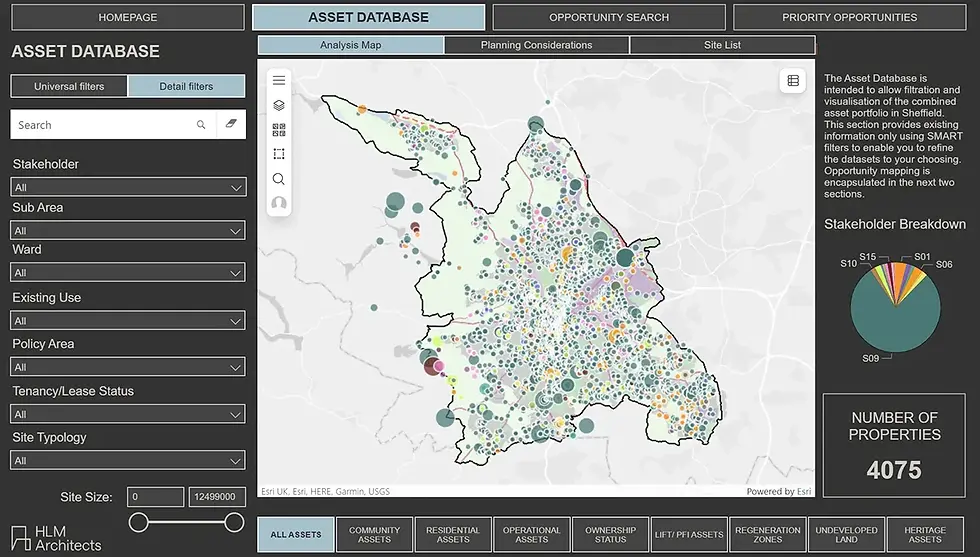
The result wasn’t just a map. It was a shared understanding — a platform for faster decisions, clearer priorities, and renewed regeneration
momentum.

This is what modern place‑making looks like: evidence‑driven, collaborative, and grounded in the real assets that shape a city’s future. This approach can also be applied to LGR.
In April 2024, the Office of Government Property commissioned a report through the One Public Estate programme to evaluate the Place Pilots initiative. The significance of digital intelligent asset mapping forms part of the evaluation which assesses how effectively the Place Pilot model facilitates change within government’s estate systems.
The full report can be found here: Place Pilots evaluation – project impact case studies | Local Government Association
A new model for Place‑led growth
As these national reforms take shape, there is a rare opportunity to redefine how places can grow. By aligning public sector assets, stable funding, institutional capital, and a more effective planning framework, LGR can become the catalyst for a new model of place‑led regeneration — one that is strategic, investable, collaborative and capable of delivering long‑term economic transformation. Intelligent asset mapping can first establish baseline LGR property data. Once those baselines are set, they can be used to prioritise strategic value, not just on collecting more data.
This creates better, more informed conversations to Place-led growth.
For some authorities, this will validate work already underway. For others, it will open new possibilities. For all, it represents a moment worth seizing — with realism, with evidence, and with a clear understanding of the property landscape that underpins every place making ambition.
So perhaps this is not just another cycle of reform. It’s a structural shift that presents an inflection point. And those who recognise it early can shape the economic future of their places for decades to come.



Comments