
MY LEGACY What has happened to my legacy – Part two

Updated: Oct 29, 2025
 | Richard is an honorary member of ACES who was President in 2004/05, a member of ACES Council for a number of years, and a stalwart of Heart of England Branch, both before and after his retirement in 2008. Up to that date he had worked for Nottingham City Council for 35 years. |
This second part of a two-part article ties in a treat (almost as if I’d planned it!) with Phil Farrell’s private sector perspective of the Broadmarsh Centre. Richard continues his account of his experiences at Nottingham City Council. Richard also promotes the benefits of ACES membership, especially the opportunity to network. |
This second article covers the period from my retirement speech in 2008, up to the present day. It attempts to explain what has happened to the legacy and offers some thoughts on the future.
Back office transformation
Six months after I retired in 2008 came the banking crisis. There were warning signs before my retirement. Silly money was being paid for development land. Developers were buying sites without planning consent, taking more risks than was healthy, and property values tumbled. This presented a great opportunity for the council to modernise its working practices and move staff from several sites to be all under one roof. The concept of agile working in an open plan environment was sold to the staff. It was obvious that there would be less money available and less staff to accommodate. A business case for a move was made: making better use of the council’s property assets and expertise was the answer for the future. The 220,000 sq ft state of the art former Capital One building on the edge of the city centre, located just north of the station, became available. It was purchased by the council at a knock down price. Some existing office properties were sold to help finance the move; by 2012 the new office, now known as Loxley House, was up and running. But other offices vacated by the move still remain empty or have been on the market for sale without success.

Loxley house is now much underused due to the reduction in staff numbers and home working. Consultants were appointed to advise on how the council could operate more efficiently and save costs. They recommended staff consolidate into the first two floors and that the other two floors are mothballed. The council decided to adapt the top two floors for letting. It then considered a sale of the building.
I suspect all of this led to the top commissioner overseeing Nottingham saying ‘it is blindingly obvious that it has not been making best use of its properties.’ He has now said, though, ‘it’s difficult to be clear about what the operational estate requirements are ... and judgement needs to be informed by local government reform (LGR)’. So for the time being the building will be retained. And some staff is even moving back in.
Political ambitions and risk taking
Until relatively recently, from the day I retired the political leadership at the council did not change. However, the chief executive and chief officers changed frequently, including those responsible for its property assets. The revenue support grant was being cut every year; greater demands were being placed on the council’s resources to meet the increase in demand-led adult social care, children’s services and homelessness costs. The council was living beyond its means.
But the Labour led council still had ambitions for the city. It now had the knowledge and power and was prepared to take risks. The introduction of prudential borrowing in 2006 presented the opportunity to go on a borrowing spree to meet these ambitions. Like a number of other councils, it used these powers to borrow to acquire property investments to replace the revenue support grant cuts. These investments were scrutinised thoroughly to assess risk by a team of in-house estates surveyors, which are generally performing well compared with some other authorities’ assets, as is the whole investment property portfolio. Many of the high yielding assets that were reaching the end of their economic and physical life have over recent years been redeveloped or sold. The council is now closing its managed business centres due to the high running costs, seemingly abandoning using property to support the growth of small businesses. This change in focus makes the branding of the investment team estate surveyors as ‘Nottingham Property Plus’ now misleading and inappropriate. The image needs reviewing and updating.
The council embarked on other less successful commercial ventures, including setting up its own Robin Hood Energy company that went bust owing £36 million. Something the leader of the council at the time has taken full responsibility for.
Broad Marsh and the city centre
Broadmarsh Shopping Centre redevelopment scheme collapses
Around the time of my retirement Stuart Rose, the then Chief Executive of Marks and Spencer, said ‘We are delighted to have secured the Westfield sites in Nottingham, Bradford and Stratford’. With an anchor store signed up it was all looking good for the Broad Marsh scheme. Then came the banking crisis; followed by the rise in online retailing. Westfield decided its mega scheme was no longer viable and a more realistic one was produced for the existing centre, to be anchored by a national upmarket departmental chain store.
A new development agreement was close to being signed when Intu made an offer to buy the leasehold interest that Westfield could not refuse. Intu had always seen the redevelopment of the Broadmarsh centre as a major threat to its Victoria Centre. The services of the national consultants advising the council on the scheme were let go: consultants I had appointed following a very thorough selection process, influenced by discussions between some ACES and private sector delegates after a few drinks in the early hours of an ACES conference.
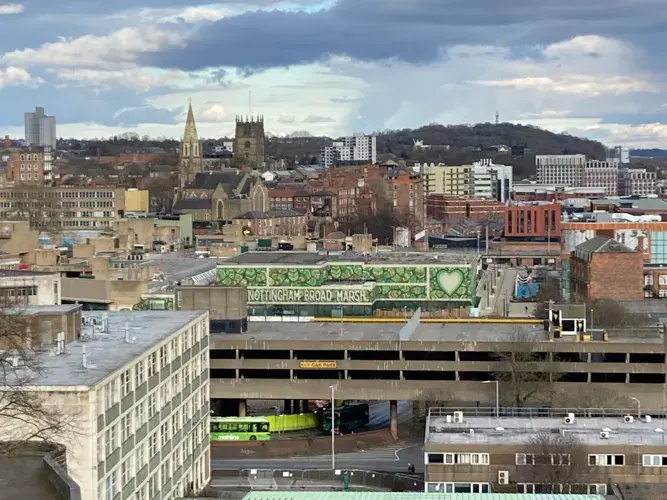
Without retail specialist advice, the council varied the existing lease terms to benefit Intu and encourage the developer to come up with its own redevelopment scheme. Intu’s scheme was a substantial remodelling of the existing centre, incorporating a significant proportion of leisure, including a cinema and ten pin bowling. This meant the council had to pick up the full cost of the new bus station, multi-storey car park, highway works, and various other associated costs: around £50m. The council decided to take a big risk, started and completed this work. Intu started the demolition; then went into receivership. It sold on the Victoria Centre but handed back the lease of the Broadmarsh semi demolished centre to the council, which then went out to wide consultation on the future of the site through the ‘Big Conversation’. They were initially persuaded to use the area predominantly as an open space biodiversity area to be known as the ‘Green Heart’. Consultants were appointed and a master plan produced which very sensibly reduced the size of the ‘Green Heart’. But it originally retained much of the skeleton of the semi demolished centre, including the dangling of greenery from the structure. Not even an original idea for the city; it was done in the Royal Hotel development in the 1980s. A novelty then that only lasted a few years.
Recovery starts
The ‘Green Heart’, promoted as a nature first wildlife rich green space and some related highway/pedestrianisation works have now been completed. The streetscape from the rail station is much improved. Peoples College has moved to the Broad Marsh east site where it has developed a new £58m Nottingham College. The council has moved its central library into part of the multi-storey car park building that was allocated for this use. The car park is well used, but by office workers not shoppers. The bus station is under used; visitors to the city catch and alight from buses at more convenient bus stops in the city centre. The shop units included in this development are all still vacant. Nottingham University Hospital Trust has agreed to develop a medical diagnostic centre on part of the site.
 |  |
Sale to Homes England
After a ‘soft’ marketing exercise, and given the significant site holding costs and financial constraints the council faces, it concluded a freehold sale to Homes England to be the most viable option. The sale price is reported to have been £8.4m plus VAT. But construction will not begin until 2029/30, then be undertaken in phases with no end stop date. The overall development site sold, now 20 acres, includes Severns House, a former council office that has been vacant and abandoned for around 15 years; the partly demolished former shopping centre; the cleared site west of the Green Heart; a hideous run-down underused NCP multi-story car park, where the council, who is freehold owner of the site, has just agreed terms with NCP for the surrender of the lease; and the former Peoples College site on Maid Marion Way.
The new East Midlands Combined County Authority (EMCCA) has awarded a £3.39m grant towards the complete demolition of the site, which will cost around £30m, start in the summer and take a year to complete. This ‘de-risking’ of the site is aimed at making it attractive to the private sector to deliver the current master plan that is for a mixed use development of around 1,000 homes; 200,000 sq ft of office; commercial and leisure use, and providing 2,000 jobs.
The site is hugely important strategically to the future of Nottingham. It is the gateway to the city centre from London and the south. There is a memorandum of understanding attached to the sale to support the master plan vision. Such agreements are not legally binding, and already there is disagreement as Homes England is proposing more student accommodation which the leader of the council does not want. My years of regeneration experience taught me that the only way to control development is to retain a legal interest in it. Even though Homes England is investing a lot of capital up front, it will be just one of many sites it is promoting throughout the country; not necessarily a priority.
Broad Marsh Master Plan delivery
Will the current master plan-led and freehold sale scheme succeed when the council is giving up its role of ‘making things happen’ by transferring control and power to the new owner? It will not move Nottingham back up the scale of national top retail destinations: the plan does not include any retail.

The recently completed ‘Green Heart’, not included in the sale, putting ‘marsh’ back in the Broad Marsh, has so far been favourably received. Residential development should not be difficult given the new owner. The office, commercial and leisure element will be more problematic: Nottingham does not have the rental values for such developments. To kick start this development, the council could build, opposite the new library, a new landmark headquarters to include a ‘one stop shop’ for all public services, then sell Loxley House. Presumably this option has been considered and rejected as being unviable: LGR may present an opportunity to reconsider. The site would benefit from some statement architecture to be a major public destination to bind it all together, not just a place for the public to pass through.

Regeneration timescales in Nottingham
Major brownfield sites in Nottingham have always taken years to complete, often passing through several economic cycles, the hands of various developers, and never built out to the original master plan vision. The largest development site in Nottingham currently is the Island Quarter to the east of the city centre. It was the flagship project for Nottingham’s ‘City Challenge’, an early 1990s government urban regeneration initiative to revitalise deprived urban areas through public/private partnership working.
I was the property officer on the council’s regeneration delivery team. This 36-acre site, former Boots chemical factory, gas station and scrap metal yard, was purchased and cleaned up by the council with the use of substantial European Union funding, then sold onto the private sector for development. Thirty years later, only half of the land is developed. There has been much recent activity on the site with the development of student accommodation. More is planned, plus laboratory space and a hotel. EMCCA has announced a grant of £3m to include some apartment development on the site. I would guess more public funding support will be needed before final completion.

Another City Challenge project, the redevelopment of the former Sneinton wholesale fruit and vegetable market to create a new vibrant and eclectic area for small businesses - intended to be Nottingham’s Camden Lock - is only now achieving this vision. This is after the council had to buy back and regain control of the market from the original regeneration specialists it was sold to, inject more public money into the market, and repurpose it, now to be a booming hub for creative and independent businesses. This success is also down partly to the combined enterprise of the tenants, rather than the council, criticised recently for not promoting the market, even though as landlords it benefits financially from the rents.

Probable Broad Marsh regeneration final outcome
More public funding will surely be needed for the Broad Marsh, for example, for the remainder of the demolition costs which presumably will now be met by Homes England. The development will also be more market - than master plan - led. My prediction is that the whole area will end up being predominantly all residential, with just a variety of other uses mainly supporting a new ‘city village’ community; the ‘Green Heart’ will survive, but not in its current form; and the council will have again built a bus station and shops in the wrong location.
City centre transformation
Since 2008 there have always been cranes on the Nottingham skyline, in almost all cases developing student apartments, much of it fronting the new inner ring road south of the station. More is planned as the two universities aim to boost the student population in the city to 60,000 (1/6 of the city population). The only other developments of scale - other than the start of the Broad Marsh regeneration - are the redevelopment of the station and Unity Square, opposite the station, a state of the art 10-storey 389,000 sq ft tower, now the new Government Hub.

The city centre itself has a rundown appearance due to the number of empty shops, particularly along the two routes into the centre from the Broad Marsh, and increase in rough sleepers. All city centres are now in trouble and are reinventing themselves. Nottingham’s centre, already becoming a ‘studentopolis’, will in the future be an area where more people will live, as well as work and play. It is steeped in history associated with its castle and lace market area. It has some great architecture. Nottingham has Robin Hood: a legend, but one that has gained a special almost magical status around the world [Ed – as Phil pointed out in the previous article].

To transform the fortunes of the city centre on a legend, its history, changing role and character to achieve a ‘contemporary and diversified space that captures the spirit of a dynamic and thriving community’; the vision of the Nottingham’s Economic Plan for Growth 2024 -30, will inevitably take some time.
Property team break up and loss of knowledge and power
There has undoubtedly been a huge power shift at Nottingham, from the officers to the politicians. Very few of my property team is left. There has been a damaging loss of in-house knowledge and expertise. The property team is now dependant on the use of consultants and agency staff. The Head of Property is only a third tier officer. During my last years I had regular meetings with the labour leadership on property. Often the property service manager attended as well. Two voices conveying the same message is better than one. By having the knowledge and experience we had the trust and respect of the leader and deputy. Demonstrating old public servant values of loyalty and commitment to the city over many years helped. We were considered to be a safe pair of hands for our property role; though unpopular when appearing to block progress, particularly when politicians, and even officers, wanted to give away assets for pet projects or take unacceptable risks [Ed – well said Richard].
Nottingham’s financial bailout by its property portfolio: the family silver
The council is in dire straits with its revenue budget, now moved from ‘terminal to critical’.
It is selling £100 million worth of its property assets to address the budget deficit. This sales programme will have an impact on its overall portfolio worth over a £1bn; but only really tarnish the ‘family silver’. Although cash poor, the council will continue to be asset rich. It will also benefit from the prudent in-house estate management of the past creating ‘clawback’ provisions in sales, future opportunities for lease re-gearings, ransom strip payments and payments for the release of rebuilding clauses in many ground leases. Just before I retired, the council sold Tollerton Airport. A planning application is just about to be submitted for the first phase of development on a site with the potential to provide 4,000 homes. The sale by the council included a ‘clawback’ clause under which the council will receive 50% of the uplift in value for development.

Some thoughts on the future
Need for an estate strategy
In the future there is likely to be fewer, but larger, single tier local authorities delivering a much reduced range of services. Working smarter and sweating the property assets will be demanded. To be successful, property must be high on the agenda: strong leadership will be required. It should raise the profile of the chief estate surveyor who should take the lead.
The job specification for the Head of Property at Nottingham requires the post holder to lead the property function and prepare and maintain the corporate property strategy. So far as I can see, one has never been written. The council has continued to produce asset management plans (AMPs) that set out the process of how assets are to be managed and maintained. They provide for regular condition surveys which significantly help in keeping premises safe while the repairs backlog is still high. But AMPs are not an estate strategy setting out how property will be used to support service delivery and regeneration. Central government departments were not required to produce AMPs before the banking crisis. After the crisis they went straight to a simple clear six page ‘estate strategy’ with just three objectives: to modernise, rationalise and support the growth agenda, a much better more focused approach that should be adopted across the whole of the public sector. The strategy will also need to set out how it is to be delivered: as a minimum by a professional strategic and intelligent client in house team; finance that is determined by references to the ‘time, quality and cost’ test, and of course the appropriate use of AI.
Prospects for future chief estate surveyors
I hope the current Head of Property at Nottingham will be successful. The recently appointed incumbent has the benefit of a good number of years’ experience at Nottingham and has worked in the private sector. But it is a ‘big ask’ for someone operating at third tier level, without direct access to both the political and chief officer leadership group.
Working in the public sector is like playing a long game. To survive you need to know the rules and stay ahead of the game. Over the years much knowledge and expertise has been lost at Nottingham and other local authorities. The public sector has become dependent on consultants who know the game rules. They now have the power, knowledge and resources. Communication is completely out of control. There is just far too much of it in the digital world. Even with the introduction of AI, for the foreseeable future, the situation will not change. Chief estate surveyors, under whatever title they operate, will not have the in-house knowledge and support of the past. To survive and deliver, even a basic intelligent client role, they will need to ‘share knowledge and experience’. Networking will be essential: just what ACES facilitates for its members.
Comments