
PLANNING REFORM Labour 2:0 - Planning reform update
  | Clare is a Director of BPS and has a range of valuation experience gained over many years, both for principals and in private practice. She joined BPS in 2020 and has since advised on projects including Earls Court, Fulham and Holloway Prison, Islington. Madison is a Director of BPS Chartered Surveyors, having worked in planning viability and valuation there for the past 6 years. She has advised on a range of significant developments including Northfleet Harbourside, Gravesham and Barnsbury Estate, Islington. |
Clare and Madison update readers on the more recent changes to the NPPF and whether these are sufficient to stimulate a faltering housing market and delivery of affordable housing. |
Much has happened since we last reported on planning reform in the 2025/26 Winter ACES Terrier. We have a new prime minister, increased focus on public sector-led construction and social rent provision, a new version of Help to Buy and, of course, a new NPPF. Our new leader has much to prove and only a maximum of 3 years until the next general election; can he prove he is more than ‘Starmer on Tik Tok’?
Last time, we concluded that increased tenant protections and innovative classes of residential may serve to make some improvements in the open market sector. On the affordable side, the offer of grant funding alone seemed unlikely to resolve the current shortfall.
We maintain that while oiling the wheels of the planning system can only help to improve housing delivery, it will not be enough on its own. This is illustrated by the many consented schemes which either await start on site or have now stalled.
Fundamentals suggest that build costs and house prices play a predominant role in influencing housing delivery in this market-driven sector. This is illustrated, where we can see in the chart, build cost growth plotted against house price growth. Between mid-2022 and mid-2024, build costs increased significantly more than house prices, causing a squeeze on the sector. We can see that starts on site consequently suffered between 2023 and 2025.
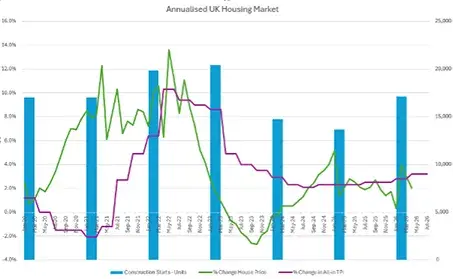
Sources: Ministry of Housing, communities and Local Government, Land Registry HPI, BCIS
Since mid-2024, costs and values have broadly kept pace, and signs of an increase in build starts (in blue) is evident. This recovery does not appear robust, though, and has been buffeted by both international conflicts and (largely justifiable) tightened construction regulations. The chart suggests that a significant calming of international geopolitics would be required for market forces to lead us out of the current housebuilding lull.
NPPF – What has changed?
At a glance, the main changes relevant to housing delivery are:
NPPF Issue | December 2024 | August 2026 |
Planning policy structure | Frequent combinations of plan-making and decision-taking | Plan-making and decision-taking now more separated |
Presumption of development | If no relevant up to date plan policies, tilted balance in favour of development; this could happen if Housing Delivery Test under 75% or lack of 5-year housing land supply | This now depends upon location:
If within a settlement, the presumption is in favour of development
If outside a settlement, presumption still in favour in certain circumstances (e.g. station schemes, infill, brownfield, allocated land), otherwise the presumption would be against development
Green Belt is dealt with separately unless Green Belt policies won’t restrict development |
National policy/Local Development Plan conflict | Appropriate weight dependent on consistency with national policy; Local Development Plan policies are the basis for the decision | This now depends on whether the local policy is materially inconsistent with national policy; this will not apply with up-to-date local policy prepared under the 2026 NPPF |
Information requirements | National policy encouraged proportionate information requirements | Now the national information framework more dominant and additional local demands are restricted |
Application stage viability | Applicant decides whether to submit scheme-specific viability assessment. Price paid for the land is not justification for failure to comply with policy | Assessment required if e.g. scheme or site type was not tested in the plan, there are unforeseen site costs or economic circumstances change significantly. The price paid for land or an option is not justification for failure to comply with policy |
Local Plan cycle | Strategic policy time horizon of 15 years and a 5-year review cycle | Strategic policy time horizon of at least 25 years, 10-year horizon for allocations and designations, and work on new local plans should begin within 5 years of adoption |
Housing need |
| New policy HO7 gives substantial weight to homes benefitting evidenced needs, which is relevant to affordable housing, disabled, older people, the military, travellers, etc |
Plan deliverability | Evidence that completions will begin within 5 years | Now more tightly defined, meaning that deliverability of certain sites within 5 years should be evidenced |
Green Belt and grey belt | Grey belt and Golden Rules apply | Green Belt development remains harmful; substantial weight should be applied to the harm, and schemes should only be granted if very special circumstances outweigh the harm. Grey-belt definition is revised, and a separate station-led route established |
Settlements and density | Density policy was less defined | Settlements and density now more tightly defined and new station-density policies |
Nature, flood and heritage |
| New flood zones and classes, restrictions on higher local BNG standards and different heritage terminology |
In general terms, the new NPPF is a tighter, more well-defined document, and should, in the long term, help to rationalise and streamline the planning process – thereby aiding delivery.
It is important to recognise, though, that this is all it can do: it may help to free up a limited amount of land for development, and will reduce some of the friction that developers are currently experiencing. It is important to consider whether planning friction is a major cause of the housing crisis relative to higher build costs and static house prices, or whether this is the only part of the equation government thinks it can impact. Arguably, the more conventional factors of supply and demand for new housing offer a more obvious explanation for the current low build volumes.
Last time, we looked at the main levers of supply and demand, and a key consideration for build costs is that much of the upward pressure (increased regulation, decreased labour availability and material supply issues) is not likely to be removed any time soon. And of course, factors such as fire safety improvements and much of the environmental regulation is entirely laudable, but comes at a time when house price increases are insufficient to cover this additional cost.
Do the British still like talking about house prices?
Looking back to 2001, before the crash, earnings growth of around 5% supported much higher housing market growth, largely due to the expansion in lending. That clearly didn’t get us very far and there is no mass call for higher loan-to-income multiples to stoke the market now.
We now have similar earnings growth, and similar lending rates, but house price growth remains faltering.
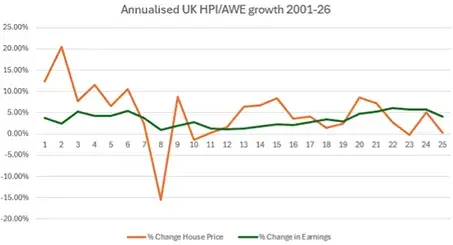
Source: Land Registry and ONS
The Office for Budget Responsibility is forecasting UK house prices increase by around 2.5% p.a. over the next 3 years. The agents, Savills are much more bullish, with forecasts of 2.5% in 2027 rising to 6% in 2029. It is likely that developers will require more house price growth than that to encourage them onto sites. However, the demand for new housing deserves a more detailed look.
Is anyone buying new build flats?
Developers are currently dismayed by the dearth of demand for flats in new build schemes across the country. The graph shows the volume of sales in Greater London, an area with a high proportion of new builds being constructed as flats, which illustrates this well. While Help to Buy has artificially propped up new build demand in recent years, the previous scheme closed for applications in late 2022.
Sales Volume in Greater London

Source: Land Registry
General housing demand is undoubtedly a factor at play here, but what else is going on? There are also many avoidable factors which are also having an impact. Many potential buyers of new build flats are put off by the bad publicity associated with the cladding scandal, high service charges, poor build quality, onerous ground leases, and consequently the poor product many developers have offered buyers in recent years. Developers now have a tough marketing job on their hands to win back buyers.
The recent announcement regarding the reintroduction of a help to buy scheme labelled ‘Your First Home’ will see deposit requirements at 2.5% and loans under the scheme of 20% for new build purchases by first time buyers in England, subject to certain conditions. While debate rages as to the potential inflationary impact and already recorded boost to housebuilders’ share prices, such schemes have previously been shown to boost building activity.
Will any affordable housing be built?
The Burnham government appears to have a new focus on housing need and in particular Social Rent (or as they shamelessly call it, ‘Council Housing’). While mandatory housing targets (totalling 370,000 p.a. nationally) have been reintroduced by the current government, national affordable housing targets are currently at 30,000 p.a. over a 10-year delivery programme. The available £39bn grant money is being deliberately steered more towards direct local authority development, in addition to housing associations, and an extra £10bn of funding has subsequently been announced. However, the 33 strategic partners to benefit include only 3 local authorities to date. Delivery times are now incredibly tight for this parliament.
And so that leaves us…
Reliant on our trans-Atlantic ‘ally’ to calm the cost of building materials, badly needing some earnings growth without prompting runaway inflation, trusting that developers can reimagine their product and invest heavily in marketing, and hoping that Burnham will roll up his sleeves and get spades in the ground pronto!
On their own, the changes to the planning system seem unlikely to have significant impact on starts on site; this is especially so given that housing targets, limited land supply, and the tilted balance have for some time put pressure on LPAs to approve applications.


Comments