
THE UK PROPERTY MARKET 2026 Opportunities, risks and implications for the public sector
   | Alexandra is Head of Commercial at Carter Jonas. With nearly 25 years of property experience, she specialises in public sector consultancy, advising clients on strategy, estate transformation and organisational change, undertaking business cases, options appraisals and asset management plans. She joined Carter Jonas in 2014 and was appointed Head of Public Sector in 2021. She has played a key role in leading many public sector relationships. Appointed Head of Commercial in 2025, she leads the division’s continued growth and strategic development. Sophie is an Associate in the Research Team, providing research, data and market analysis across a wide range of property asset types. Predominantly, she supports the commercial, rural and infrastructure divisions, producing regular market updates and thematic research to inform valuations, estate strategy, development, leasing and investment decisions. David is a Partner in the valuation team based in Oxford and London. He is responsible for managing the delivery of valuation advice to both public and private sector clients across South-East and South-West England. Over the past 15 plus years, David has acted on behalf of local authorities in relation to expert witness matters, the provision of best value advice, and the provision of annual asset valuations of operational, investment and surplus portfolios. |
The members of the CJ team kindly agreed to put together a composite article of their conference presentations (saving me a whole lot of work, thank you). This article examines the current market backdrop, recent policy developments, and implications for local government decision-makers. |
The UK property market is showing signs of recovery, but the path forward remains uneven. Economic conditions have stabilised, yet growth is modest and cost pressures persist.
Across housing, commercial property and land, demand is increasingly aligned with long-term structural trends, while viability pressures and policy continue to shape market behaviour.
Economic backdrop: stability without momentum
The UK economy continues to grow, but at a relatively subdued pace. The September 2026 average of independent forecasts compiled by HM Treasury points to GDP growth of around 1.2% in 2026, reflecting an economy that has proved more resilient than many anticipated, but remains below longer-term trends. Service sector activity, particularly in technology, science and professional services, continues to support growth, while construction remains a drag on economic performance.
Inflation has fallen significantly from the peaks experienced in 2022 and 2023, but remains above the Bank of England's target. Businesses are now operating from a structurally higher cost base, while ongoing geopolitical tensions and energy market volatility continue to create uncertainty around future inflation and interest rates.
For property markets, the result is an environment of selective rather than broad-based recovery. Occupier demand remains strongest in structurally supported sectors, particularly technology and science, while financing and development costs continue to constrain investment and viability.
Housing recovery faces affordability constraints
Housing activity recovered towards longer-term norms during 2025 as borrowing costs eased and confidence improved. By early 2026, transactions and mortgage approvals were close to historic averages. However, that recovery lost momentum from March 2026 as geopolitical uncertainty and renewed interest-rate concerns lifted mortgage costs and dampened buyer demand.
The effects have not been evenly distributed. Homes below £500,000 have outperformed higher price bands since 2020 (see figure 1), supported by a larger buyer pool. Higher-value homes have a narrower purchaser base and tend to be more sensitive to financing costs and affordability constraints. There is also a clear split by property type (see figure 2). Flats have underperformed compared to houses, affected by a combination of leasehold uncertainty, cladding concerns, rising service charges, and a continuing preference for larger homes. The weakness has been particularly pronounced in London.
Figure 1:
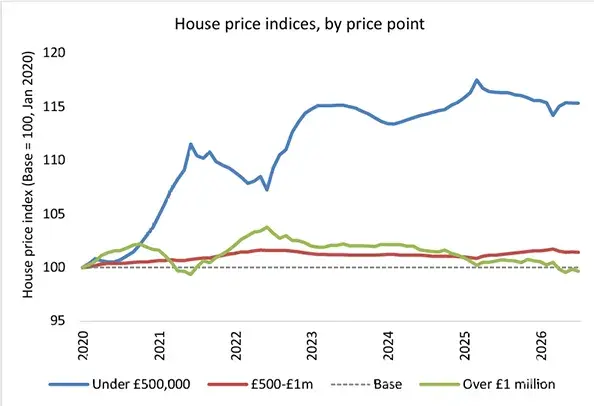
Source: REalyse, using HM Land Registry (12 month rolling averages, England)
Figure 2:
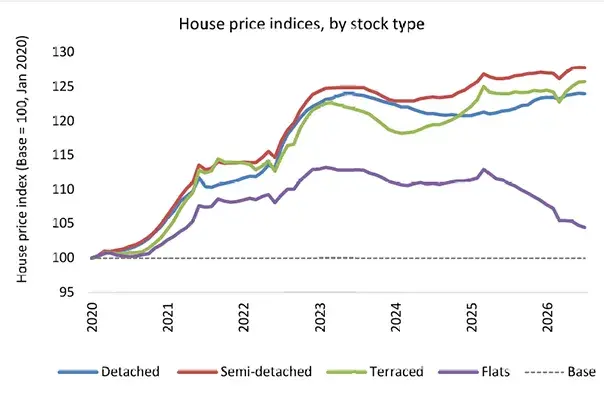
Source: REalyse, using HM Land Registry (12 month rolling averages, England)
Confidence and sales rates influence the pace at which consented schemes proceed and what affordable housing or infrastructure they can support. Government ambition includes 1.5 million net additional homes in England over the current Parliament, and long-term funding for social and affordable housing. Yet delivery still depends on land assembly, infrastructure, finance, construction costs and market absorption. Policy ambition alone does not resolve these practical constraints.
Turning housing ambition into delivery
Across housing policy, delivery remains the central challenge. Additional funding for social and affordable housing is welcome, but registered providers must also fund repairs, building safety, stock improvement and decarbonisation, limiting capacity for new development.
Reform of the private rented and leasehold sectors adds further complexity. It remains unclear how far recent rental supply reductions relate to the Renters' Rights Act, but any further contraction could increase pressure on homelessness services, temporary accommodation, and affordable housing. Leasehold reform may also affect councils with freehold interests, regeneration schemes and ground-rent income.
For local authorities, the challenge is therefore becoming broader than housing delivery alone. Alongside the need to support new development, councils must balance growing demands for affordable housing, maintain and upgrade existing stock, and respond to evolving regulatory requirements. While government policy and funding can help create the conditions for growth, housing outcomes will ultimately depend on the ability to overcome longstanding constraints around land, infrastructure, viability, funding and delivery capacity.
Selective recovery in commercial property markets
Commercial property markets continue to recover from the correction triggered by higher interest rates, although performance varies significantly across sectors and locations.
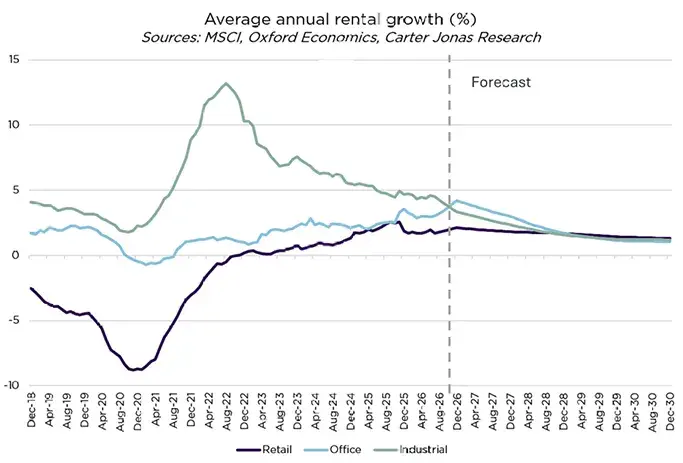
Industrial property remains one of the strongest performing sectors. After experiencing exceptional rental growth during 2021 and 2022, growth has moderated, but remains above long-term averages in many prime locations (see figure 3). Retail has also improved considerably following the disruption of the pandemic years, supported by limited new development, stronger retailer confidence, and renewed demand for dominant locations and retail warehousing. Offices have proved more resilient than many expected, although performance remains highly concentrated in the best-quality buildings.
Rental growth is expected to moderate across all three sectors over the forecast period, with the gap in performance narrowing as office, industrial and retail markets gradually converge towards more sustainable long-term growth rates.
Figure 3:
National trends increasingly hide significant differences between assets. Across industrial, office and retail markets, demand remains strongest for prime properties in the most desirable locations, while secondary assets face growing competitive pressures. As occupiers place greater emphasis on quality, sustainability and operational efficiency, this polarisation is becoming more pronounced.
Investment markets are also showing signs of improvement. Investment volumes remained relatively stable during 2026, and the annual total has continued to recover gradually. However, investors remain highly selective. Traditional sectors such as offices, industrial and retail remain below historic transaction levels, while alternatives including healthcare, living and hotels continue to attract strong interest because of their long-term demographic and income characteristics.
Capital values are forecast to recover gradually across the major sectors (figure 4). Retail is expected to deliver the strongest growth over the medium term, benefiting from attractive pricing and constrained supply. Industrial values are forecast to rise more steadily, while office recovery is likely to be slower and concentrated in the highest-quality space.
Figure 4:

Changing occupier needs and regulatory pressures
A key trend is the rise of the owner-occupier. In parts of the office market, lower capital values and higher rents have made buying more attractive relative to leasing. Occupiers may also value greater control over costs and long-term certainty over their workspace. This could create disposal opportunities for local authorities, including sales to existing occupiers, but only where a transaction supports the wider estate strategy, rather than delivering a short-term receipt at the expense of longer-term objectives.
Policy and regulation are also exerting a growing influence on commercial markets. Business rates reform, energy policy, and minimum energy efficiency requirements may affect values and occupier demand.
The government has proposed that privately rented non-domestic buildings over 1,000 sq m in England and Wales achieve an EPC B rating, where cost-effective, from 2031. Although subject to secondary legislation, this already presents a significant investment consideration for owners.
For local authorities, the commercial property market reinforces the need for active estate management. Decisions about which assets to retain, invest in, repurpose, or dispose of will become increasingly important. The divergence between stronger and weaker assets means that maintaining a clear and proactive estate strategy is likely to be more important than ever.
The changing role and value of land
Average farmland values in England and Wales have been adjusting since early 2025. Over the last year, average pasture values have fallen by 1.4% and arable values by 2.0% (12 months to Q3 2026). However, headline movements only tell part of the story. The market is becoming increasingly polarised, with good-quality farmland continuing to attract competitive demand, while secondary land and assets with limited alternative-use potential face a more selective buyer pool.
Weaker farm profitability has been a key factor behind this shift. Challenging harvest conditions, drought, labour shortages, and elevated input costs have reduced confidence across parts of the agricultural sector, limiting both the appetite and capacity for expansion among many farming businesses. Ongoing uncertainty surrounding agricultural support payments and wider Defra policy has also encouraged a more cautious approach to decision-making.
Despite these headwinds, demand remains supported by a diverse range of buyers, including natural capital investors, expansion-focused farming businesses, and purchasers deploying rollover funds from development disposals. However, this demand is unevenly distributed and increasingly concentrated on land that offers scale, quality or alternative-use potential.
Natural capital is playing a more strategic role in land-use decisions. Biodiversity Net Gain (BNG) is the clearest example, having evolved rapidly from a niche consideration into an established and active market. Demand for off-site biodiversity units continues to grow, and an increasing number of habitat banks are being registered. Further momentum may follow when mandatory BNG is extended to Nationally Significant Infrastructure Projects in England from November 2026, potentially increasing demand for off-site units in the coming years.
Infrastructure remains another important consideration. While there is strong political support for growth and development, delivery continues to be constrained by funding pressures, long lead-in times, and increasing concerns around grid capacity. In many locations, access to power infrastructure is becoming a critical factor in determining whether schemes can progress.
More broadly, land is becoming increasingly contested. Housing, infrastructure, biodiversity, food production, renewable energy and nature recovery all compete for finite resources. This means local authorities must increasingly view land as a strategic asset capable of supporting multiple policy objectives.
Navigating the opportunities ahead
The outlook for UK property is improving, but the recovery is not uniform. A more stable economic backdrop is providing a firmer foundation for activity, yet weak growth, high costs, and affordability pressures continue to constrain demand and development. Across housing and commercial property, performance is strongest in well-located, efficient assets that offer quality, efficiency and long-term relevance.
Land is also being reshaped by both pressure on agricultural returns and growing competition from housing, infrastructure, renewable energy and natural capital, broadening the drivers of value, and creating opportunities for assets capable of supporting multiple uses and outcomes.
The outlook is therefore one of cautious improvement, shaped by opportunity and constraint. Across the property and land markets, outcomes will depend on the strength and sustainability of demand, the investment required to meet changing needs, and the extent to which policy ambition can be translated into viable delivery. Those able to respond to these shifts with a clear, long-term approach will be best placed to manage the risks and capture the opportunities ahead.
Detailed analysis
To discuss what these trends could mean for your organisation, please get in touch with the Carter Jonas team. For more detailed analysis of the UK property and land markets, visit the Research and Insights section of the Carter Jonas website.


Comments