
ASSET MANAGMENT SYSTEMS Platforms in place, value unproven: the state of property asset management systems in local government

 | Andrew is a Partner of Remit Consulting LLP and advises property investors and agents on business strategy and technology. As a chartered surveyor, he worked in property management, agency, rent review and strategic corporate property advice, before becoming a management consultant at Ernst & Young. At E&Y, he co-founded the Real Estate Information Solutions team and then, in 2003, founded Remit Consulting LLP. |
The 2025 ACES Property Asset Management Systems Survey was delivered by Remit Consulting, in partnership with ACES, exactly a decade after the firm’s first benchmark survey in 2015. The survey was conducted across 40 UK local authority estates teams. The findings paint a detailed picture of how the sector uses, funds, and thinks about its property systems. Some of what they reveal is encouraging. Some of it should prompt serious reflection. |
Context
Property asset management systems sit at the heart of how local authority estates teams do their jobs. They hold lease data, asset registers, compliance records, and financial information. They are the operational backbone of teams that manage some of the most complex and consequential property portfolios in the country.
Yet until now, the sector has had relatively little independent data on how those systems are performing, how satisfied teams are with them, and whether the investment they represent is delivering measurable value. The 2025 ACES survey, which we delivered in partnership with ACES, was designed to address that gap. Forty respondents, 31 questions, and a broad set of themes covering system choice, data quality, workloads, staffing, and the emerging role of AI and automation.
The results are worth reading carefully, not because they tell a simple story of success or failure, but because they reveal a sector at a genuine inflection point.
The graphs and charts illustrate these results.
A consolidated market, built on varied foundations

One of the clearest findings is how far the market has standardised. Three quarters of councils now rely on software companies, and a small number of platforms account for most users. Concerto leads the field at 30% of respondents, with Civica/Technology Forge and Idox Uniform also widely used. A decade ago, bespoke in-house platforms were far more common. Today they are the exception.
That consolidation reflects something practical. Sustaining an internally developed system in a constrained IT environment is increasingly difficult, and most councils have recognised the benefits of working with specialist suppliers who have the scale and resources to maintain and develop platforms over time. The shift is less a strategic choice than a rational response to operational reality.
What the headline numbers obscure, though, is the variety underneath. Systems in current use range from nine years old to a platform with a heritage stretching back nearly fifty years! The median implementation year is 2015, which means many platforms are now approaching, or have passed, a natural renewal point. Adoption years span 1990 to 2025. This is not a sector that has modernised in a single wave: it is one that carries a wide range of legacy alongside its newer investments, and the implications of that vary considerably from one authority to the next.
Heavy workloads, static teams

The survey's most striking findings are not about systems at all. They are about people.
Three quarters of respondents describe their current workload as heavy or extremely heavy. Only a quarter feel it is manageable, even allowing for the fact that most describe it as stretched. At the same time, team sizes have remained largely flat. Over the past two years, headcount has reduced in a third of authorities and stayed the same in 40%. Looking ahead, 55% expect no change in team size, and a fifth anticipate further reductions.
This is the context in which property systems operate. Teams are being asked to do more, with the same or fewer people, and they are increasingly looking to technology to absorb that pressure. Systems are no longer just tools for recording information; they are expected to support compliance, enable reporting, and help overstretched teams function effectively.
Whether they are doing that is a harder question to answer. The modal number of daily active users across surveyed councils is fewer than five, even in organisations with large property teams. System access may be widespread, but day-to-day engagement is limited. That gap, between the system as a potential resource and the system as a lived tool, is one of the survey's more thought-provoking details. The question it raises is a fair one: are modern property platforms genuinely reducing workload, or are they simply helping teams survive it?
Spending money without measuring results
If the workload data is striking, the measurement data is uncomfortable.
Only 17% of councils formally measure the benefits their property system delivers. That means four out of five authorities are spending real money on platforms they have no structured way of evaluating. Annual spend across the survey ranges from under £25,000 to well over £250,000, yet the data shows no correlation between spend and satisfaction. Higher investment does not produce higher satisfaction scores. Some of the most satisfied councils spend modestly. Some of the least satisfied spend significantly more.
Our survey report describes this as a cycle of "spiral replacement": systems are procured, implemented, and eventually replaced, without anyone establishing whether the previous system delivered what was expected of it. That is a pattern the sector cannot afford to continue, particularly as expectations of what systems should deliver keep rising and budgets remain tight.
This matters beyond the immediate question of value for money. Without clear KPIs and a structured approach to post-implementation review, councils cannot demonstrate to senior leadership that their systems are working, cannot identify where performance could improve, and cannot build a credible case for future investment. The gap between expenditure and evaluation is not just a missed efficiency: it is a governance issue.
Data quality: one-off gains, ongoing risk
 |  | 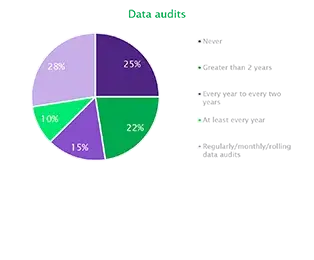 |
The survey asked councils to rate their data quality before and after system implementation. The results are genuinely encouraging on the surface: the proportion rating data as good nearly tripled after go-live, and those rating it as poor dropped significantly. The number reporting excellent data quality also doubled post-implementation.
These are real improvements, and they reflect the sustained effort that most councils put into data cleansing when a new system is introduced. The problem is what tends to happen next.
A quarter of respondents have never conducted a data audit since implementation. Only 28% carry out audits on a rolling or regular basis. Our analysis notes that councils which audit regularly report more consistent and reliable data outcomes, and that where governance is weak, the gains achieved during implementation risk eroding over time.
This is a familiar pattern in any sector that invests heavily in project-time improvements but struggles to sustain them in business-as-usual operations. The investment in data quality at go-live is real; the discipline required to maintain it is harder to embed and easier to deprioritise when teams are already under pressure.
It also has direct implications for AI readiness. AI tools, including the lease data abstraction and reporting functions that many councils are now exploring, depend on data that is structured, accurate, and up to date. Councils that allow data quality to drift after implementation are not just losing the benefit of their own investment; they are also limiting their ability to make effective use of the next generation of tools.
AI: growing interest, realistic expectations
 |  |
AI adoption across the surveyed councils is at an early stage. Only 8% are actively using AI in their property function. A further 24% are currently exploring it, 39% plan to explore within the next 12 months, and 29% have no current plans.
Where AI is being used, lease data abstraction is the most common application, followed by data analysis and reporting. These are practical, well-suited use cases: they involve structured, repetitive tasks where automation can genuinely reduce manual effort.
One finding is worth pausing on. Councils that are already using or exploring AI are not more satisfied with their systems overall than those that are not. In fact, the highest average satisfaction scores in the survey come from councils that use no AI at all. This is counterintuitive, but it is probably less a reflection on AI than on the underlying factors that drive satisfaction: system quality, supplier support, integration, and data foundations. Those things matter more than any individual tool layered on top.
The lesson is not that AI is without value. It is that AI is not a shortcut. Councils that invest in governance, data quality, and effective integration will be better placed to benefit from AI when they introduce it than those that adopt it without those foundations in place.
What Local Government Reorganisation changes about all of this
Our findings take on additional weight in the context of local government reorganisation (LGR), and the merging of multiple authorities, with multiple property systems, multiple datasets, and multiple approaches to data governance and compliance. The vulnerabilities we identified, including weak audit disciplines, inconsistent data quality, limited daily system engagement, and the absence of benefit measurement, are exactly the ones that reorganisation will expose and amplify.
Bringing together two or three authorities is not simply a matter of choosing which system to keep and migrating the data. It means reconciling different data standards, assessing systems that may be at very different points in their lifecycle, and establishing governance frameworks for an estate that may be significantly larger and more complex than any of the predecessor organisations managed individually.
Our survey makes the case clearly: LGR requires early system integration planning, not as a technical afterthought but as a core strand of the reorganisation programme. Property data and property technology need to be on the table at the same time as governance structures and service delivery models. Estates professionals who can articulate the system landscape, its risks and its opportunities, are not just implementers in this process. They are strategic partners.
Looking ahead: stewardship, not replacement
Comparing the 2025 survey to the 2015 benchmark, we describe the past decade as one of steady maturation rather than disruption. Platforms have standardised, legacy has aged, and the sector's attention is now shifting from adoption to optimisation.
That framing feels right. The technology foundations are largely in place. Most councils have a system. The question now is whether they have built the organisational discipline around it to extract genuine value from it.
Our findings point consistently towards the same set of priorities: measure system outcomes properly; embed routine data governance rather than relying on project-time clean-ups; invest in integration so that property systems talk effectively to financial and document management platforms; and treat the asset management system as living infrastructure rather than a static purchase. None of that requires a new procurement exercise. It requires clearer governance, better business cases, and a more strategic approach to the tools the sector already has.
The opportunity is there. Our survey provides an honest baseline from which to move forward.
The full ACES Property Asset Management Systems Survey report is available from Remit Consulting. For further information or to discuss the findings, contact Andrew Waller at andrew.waller@remitconsulting.com.


Comments