
FREEMEN-ON-THE-LAND Pseudo law, possession and protecting council assets

 | David is an authorised High Court Enforcement Officer with around 40 years’ experience in specialist evictions and enforcement. He is the director for corporate governance and compliance at The Sheriff’s Office and regularly works with the National Eviction Team, both companies being part of High Court Enforcement Group. He has a wealth of experience in dealing with high profile enforcement operations and has planned and led operations to remove demonstrators from complex locations, including St Paul’s Cathedral (OCCUPY!), Admiralty Arch, Parliament Square, Bexhill-Hastings by-pass, nuclear power sites, and numerous fracking sites, including Balcombe. |
Something I hadn’t heard of, David here explains the beliefs of Freemen-on-the-Land and how safely to deal with them in law. |
Beliefs
For many local authorities, “Freemen-on-the-Land” (FoTL) are a growing problem – turning straightforward possession work into high risk, resource-intensive projects, and undermining council tax collection with pseudo law.
FoTL believe that legislation and court orders only apply if they personally agree to it, and that, by withholding consent, they can prevent enforcement. They misinterpret documents as Magna Carta and the Bill of Rights to say that they supersede modern statute. They claim that local authorities are “corporations” engaged in private contract, rather than public bodies exercising statutory powers.
These ideas, imported from the North American “sovereign citizen” movement, gained traction in the UK from the late 2000s via online forums and social media, and is now widespread across debt recovery and possessions.
FoTL may style themselves as “Common Law Court diplomats”, brandishing documents from supposed “courts” which have no status in UK law, and claiming that these instruments stay enforcement. They may challenge the validity of a writ of possession because it is a digital copy and lacks a “wet‑ink” judicial signature, despite the fact that this is not required for the writ to be valid. They may also give:
Unusual documentation and titles, made up court orders, invented badges of office, and references to “common law constables” – there is no such thing in UK law
Assertions that clause 61 of Magna Carta allows them to reject modern legislation or convene their own “juries” to sit in judgment on councils, despite those clauses being long cancelled and never having such meaning
Physical obstruction of evictions by activist groups who believe they are resisting unlawful actions by councils, enforcement agents or mortgagees.
The legal position
The key point is that none of this alters the legal position. Courts across the UK, and other common‑law jurisdictions, have repeatedly rejected FoTL arguments as having no legal basis.
When land or property is occupied by trespassers, protestors or defaulting occupiers, a writ of possession remains the most robust method of recovery. A possession order, usually obtained in the County Court, can be transferred to the High Court for enforcement by a High Court Enforcement Officer (HCEO), who will then obtain a writ of possession.
If the possession order is against persons unknown, there is no need to obtain court permission to transfer the order up to the High Court.
The advantages of a writ of possession include:
It is an absolute remedy, commanding the HCEO to deliver vacant possession
The HCEO may use reasonable force where necessary and can require police attendance to execute the writ safely
Obstruction of an enforcement agent acting under a court order is a criminal offence under s10 of the Criminal Law Act 1977, with imprisonment and/or a level 5 fine on conviction
If there is a re‑occupation, a further writ of restitution can be obtained to remove returners without starting fresh possession proceedings.
Council preparation
The operational emphasis for local authorities should be on preparation: robust risk assessment, early engagement with enforcement partners, securing a Computer-Aided Dispatch reference, and early liaison with the police where resistance is likely, and planning post‑eviction security (for example, physical barriers, alarms, guardians or K9 units) to minimise the risk of re‑occupation in the critical 24–48 hours after enforcement.
If there is likely to be media coverage, almost a certainty with social media, a communications plan is necessary.
Case studies
 | 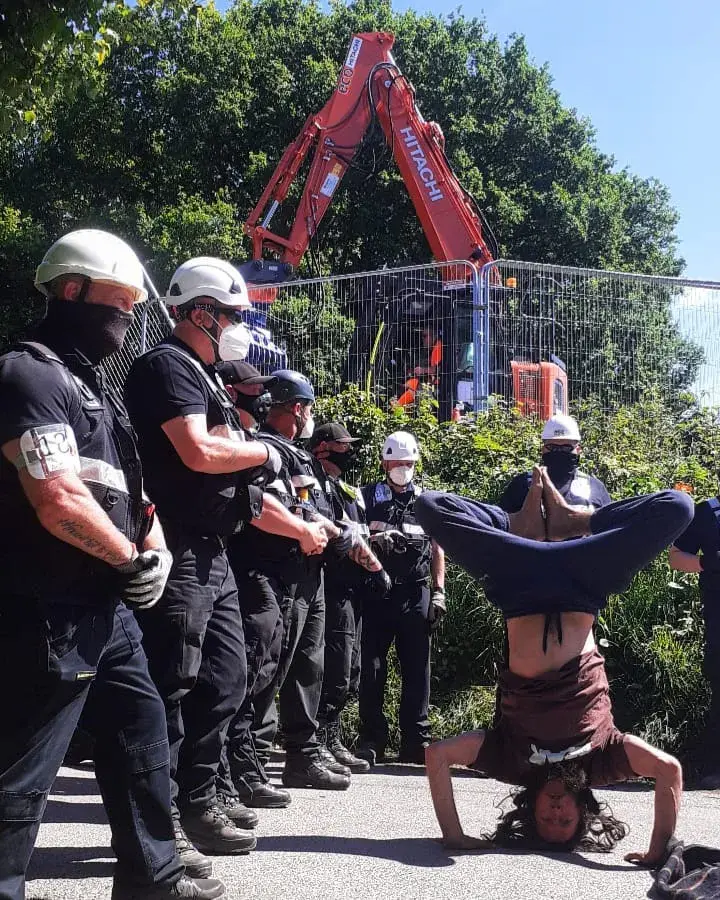 |

The images illustrate three separate cases of FoTL evictions.
To give an example of FoTL in action, the eviction of Nottinghamshire homeowner Tom Crawford became a touchstone for FoTL activists. Following a long‑running mortgage dispute, Mr Crawford was evicted by one of our Group companies, The Sheriff’s Office, after losing possession proceedings. It attracted large‑scale support from protestors aligned with freeman‑type arguments, who attempted to resist enforcement and later “reclaimed” the property. His case illustrates several practical themes for estates managers:
FoTL rhetoric can rapidly transform a private or technical dispute into a public‑order issue, drawing in hundreds of supporters and significant police resources
Activists frequently present the eventual enforcement as illegitimate, even where courts at multiple levels have rejected their arguments and upheld the claimant’s rights, which can undermine public understanding of lawful possession work
Using specialist enforcement teams who have expertise and experience in this area is essential.
When it comes to council tax, FoTL use the same arguments – no contract, no consent, “straw‑man” theories separating the “living man” from their legal persona – to claim they are not liable for council tax, with courts repeatedly confirming that liability arises from statute, not agreement.
Co‑ordinated policy and training across revenues, legal and estates functions can pay dividends: shared templates for responding to FoTL correspondence, clear internal guidance on recognising pseudo law, and agreed escalation routes when behaviour crosses into threats or organised obstruction.



Comments