
RENTERS RIGHTS ACT Good intentions vs strained capacity: What the Renters Rights Act really means for the public sector

 | Dee is an Associate and Property Litigation Solicitor at Holmes & Hills Solicitors. She advises landlords, tenants and property owners on a wide range of property disputes, providing practical and commercially focused legal advice. |
Dee puts forward some searching questions about implementation and implications of the Renters Rights Act: “for all its good intentions, risks aggravating a system which is already full of competing pressures that overwhelm local authorities and public services.” |
The Renters Rights Act 2025 has been the most significant shake-up of the private rented sector since the Tenant Fees Act 2019. Its objectives are ambitious: stronger protections for tenants, the abolition of "no-fault" evictions, the introduction of a Private Rented Sector Ombudsman, and a host of enhanced enforcement powers for local authorities. For renters, the legislation promises greater security and higher standards, but behind the enticing headlines lies the most important question: is the public sector even equipped to deliver on these promises?
As a solicitor specialising in property litigation, advising both public and private sector clients, I find myself increasingly concerned that the Act, for all its good intentions, risks aggravating a system which is already full of competing pressures that overwhelm local authorities and public services.
Pressure on an already strained system
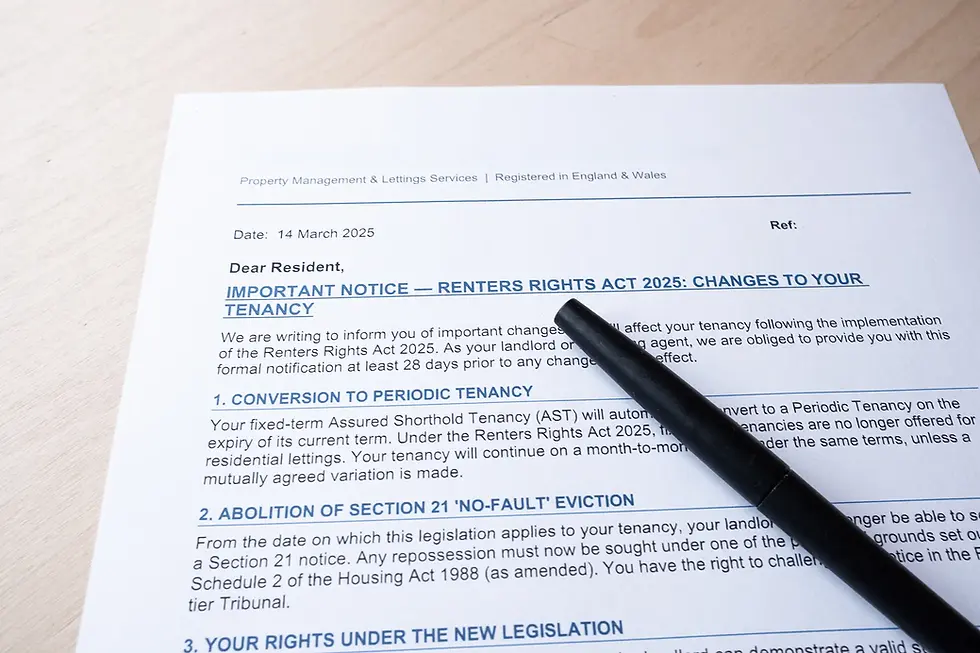
AdobeStock images reproduced under author licence
The private rented sector currently houses approximately 4.6m households in England. A significant proportion of these are owned by smaller, individual landlords — the so-called "accidental" or "amateur" landlords who may own one or two properties. For many of these landlords, the cumulative weight of regulatory change over recent years, from the Tenant Fees Act to changes in mortgage interest tax relief, has already caused significant struggle, and the Renters Rights Act may well prove to be the final straw for these groups especially.
The abolition of Section 21, while implied to be positive for tenant security, fundamentally alters the risk profile of property investment for smaller landlords. The prospect of navigating an expanded set of prescribed grounds for possession through a court system already significantly struggling under the weight of a significant backlog is, for many, simply not worth the standard benefits. Industry surveys have consistently suggested that a meaningful proportion of landlords intend to sell up in the wake of the Act, and I have already seen some evidence of this with my own client base.
The immediate consequence for the public sector is stark. Every property that leaves the private rented sector is a property that is no longer available to house tenants who may be limited to no other alternative options. Local authority housing teams, already operating with waiting lists that stretch into the thousands, face the prospect of increased demand for social housing, temporary accommodation, and homelessness services. Considering the current advice tenants receive on a daily basis is that they cannot be assisted until a bailiff is knocking on their door; it does not bode well where the number of rented properties will continue to decrease.
The uncomfortable reality is that the Act's protections, by making it harder for landlords to regain possession of their properties, will likely paradoxically accelerate the reduction of the very housing stock those protections are designed to regulate.
With expanded powers comes greater responsibility
Perhaps the most significant operational challenge the Act presents to the public sector lies in the expansion of local authority enforcement responsibilities.
Under the new framework, local authorities gain enhanced powers to investigate and penalise non-compliant landlords, including the ability to impose civil penalties of up to £40,000 for certain offences. The introduction of a national Property Portal and a mandatory Decent Homes Standard for the private rented sector will generate substantial new regulatory obligations. Local authorities will also be expected to play a central role in supporting the new Ombudsman service, handling referrals and coordinating enforcement action where landlords fail to comply with Ombudsman decisions.
On paper, these are welcome developments. In practice, they raise a fundamental question of capacity.
Many local authority housing enforcement teams are already operating on skeleton staffing levels. Environmental health officers, trading standards professionals, and housing inspectors - the very people who will be on the front line of delivering the Act's ambitions - are in critically short supply.
The Act introduces new legal frameworks, new procedural requirements, and new decision-making responsibilities that will by its nature require significant investment in training and professional development. Officers who have spent their careers working within the existing regulatory architecture will need to be upskilled rapidly to navigate the new landscape. The learning curve is steep, and the margin for error is slim. Poorly executed enforcement action invites legal challenge, wasted resources, and reputational damage and a further stall in the much-anticipated improvements that have been promised for so long.
There is, as I understand at the time of writing, no ring-fenced central government funding to support local authorities in meeting these expanded obligations. The expectation appears to be that the revenue generated from civil penalties will, over time, create a self-funding enforcement model. This is optimistic at best. Penalty income is inherently unpredictable, and the upfront investment required to build enforcement capacity must come from somewhere. For councils already making difficult choices about which statutory services to prioritise, the maths simply does not add up.
Standards vs consistency

Even assuming that the resource question can be addressed, a further challenge of consistency looms.
The private rented sector is national. Tenants in Witham deserve the same standard of protection as tenants in Kensington. Yet the devolved nature of local authority enforcement means that the quality and rigour of regulatory oversight will inevitably vary from one authority to the next.
Some councils have well-established, proactive enforcement teams with a track record of taking robust action against rogue landlords. Others, through no fault of their own, lack the infrastructure, expertise, or political will to do the same.
The risk is that the Act creates a two-tier system – not between landlords and tenants, but between tenants in well-resourced areas and those in areas where enforcement is, in practical terms, little more than notional.
Without a credible mechanism for monitoring and benchmarking local authority performance, and without meaningful consequences for underperformance, there is a genuine danger that the Act’s protections will exist in theory but fail to materialise in practice.
The proposed Property Portal arguably offers some cause for cautious optimism. A centralised, publicly accessible database of landlord registrations and compliance records has the potential to improve transparency and reduce the information asymmetry that has historically lessened effective enforcement. But a database is only as useful as the infrastructure that sits behind it. Data without action is merely more admin.
Looking ahead
None of this is to suggest that the Renters Rights Act is misconceived or flawed in theory.
The private rented sector has needed meaningful reform for years, and the Act represents an attempt by the government to rebalance what most believe to be a relationship that has too often been weighted against tenants. However, legislation which aims to completely resurface this balance needs to have completed the due diligence in remedying the flaws already present, before overhauling the entire system. Otherwise, it simply adds to the backlog of the court system as well as the public bodies, which in practice will make it worse for tenants.
What is actually needed now is an honest, pragmatic conversation addressing funding, workforce planning, training, and the development of robust, consistent enforcement standards. It must acknowledge that ambition without resource is redundant. The Renters Rights Act has changed and will continue to change the landscape. The question now is whether the public sector will be given the tools to navigate it, and hopefully sooner rather than later.
If you would like to discuss how the Renters Rights Act may affect your organisation, or require advice on housing disputes, regulatory compliance or property litigation, please get in touch with Dee Karatay or a member of the Holmes & Hills Property Litigation team www.holmes-hills.co.uk



Comments